
Old Paint and Garage Chemicals: Where Each Kind Actually Goes
At a glance: Sort intact containers by label before planning a drop-off. Paint and other garage chemicals may need separate destinations. Check your city, county or state waste authority for local options, and confirm accepted products, limits and hours before you go.
A garage cleanout often stalls at the shelf of paint cans. They look like one problem, but they may need several different exits. The leftover wall paint, the deck stain and the unmarked bottle beside them do not automatically belong in the same load.
Whether you are clearing your own garage or helping a parent prepare for a move, start with the labels and the condition of the containers. You can make useful progress without opening a single can.
Start with four groups
Inventory containers where they are. Move only those that are closed, intact and safe to handle. Use these four groups:
- Water-based house paint: labels may say latex, acrylic or water-based.
- Oil-based paint and related finishes: oil-based or alkyd house paint, plus stains, sealers and varnishes. Confirm the specific product’s eligibility.
- Other garage chemicals: thinners, solvents, pesticides, automotive fluids, adhesives and spray paint.
- Unknown or damaged containers: missing labels, badly corroded cans or anything leaking.
Keep original labels attached. Do not combine leftovers to save space. The EPA warns that incompatible household chemicals can react, catch fire or explode.
If a container is corroding or you are unsure it is safe to move, stop and ask your local hazardous-waste authority for handling instructions. Clearing the shelf can wait.
House paint: check PaintCare first
If your state has a PaintCare program, its drop-off locator is a useful first stop for both latex and oil-based house paint. Eligible products also include many primers, stains, sealers and single-component clear finishes. A participating paint store is not a general chemical-disposal site.
PaintCare’s accepted-products guidance requires original containers no larger than five gallons, the manufacturer’s printed label and a securely attached lid. Open, leaking, empty or unlabeled containers are not accepted. The five-gallon container limit is separate from how much a location can take per visit.
Paint thinner, mineral spirits, spray paint, automotive paint, craft paint, caulk, epoxy and glue are outside the program. Check the product list rather than assuming that everything used for painting qualifies.
Participating PaintCare sites accept eligible paint at no additional drop-off charge. Call ahead to confirm the products, quantity and hours. If PaintCare is not available where you live, ask your local waste authority about other recycling or collection options.
Latex paint: drying it out is a local fallback
Some communities allow fully solidified latex paint in household trash; others use different collection rules. Check with your city or county waste agency and your hauler before choosing this route. A disposal method allowed in one community may not be allowed in yours.
Before hardening latex paint, ask your waste agency or hauler whether it is allowed and how the can must be prepared. If permitted, follow its instructions and any paint-hardener directions. Keep the work area protected from rain and inaccessible to children and pets. Do not apply this method to oil-based paint or unidentified liquids.
Where paint recycling is available, check that route first. It may save you the time and mess of drying out several cans. Never put liquid paint in household trash or pour it down a drain.
Find disposal options where you live
In the United States, start with your city or county solid-waste department, public works office or household hazardous-waste program. If local guidance is hard to find, check your state’s environmental agency for the appropriate contact. Search for “household hazardous waste” with your city or county and state.
Paint and other chemicals may need separate destinations. Ask whether your items should go to a paint-recycling partner, a permanent collection facility or a scheduled collection event. Do not assume that a nearby paint store or transfer station accepts every product.
Before loading the car, confirm which products are accepted, any residency requirements, quantity limits, fees, appointments and current hours. Ask for packing instructions for your particular load, especially if a container is damaged or its contents are unknown.
Use current official guidance rather than an old brochure or a rule from another county. If instructions conflict, call the receiving program before leaving. Outside the United States, contact your municipal waste service or regional environmental authority for the rules where you live.
Other chemicals: ask about each product
Contact your county or city solid-waste office for the appropriate household hazardous-waste program. Ask about the actual items: a bottle of solvent, a pesticide, leftover fuel or a partly full spray can. Acceptance, fees, appointments and quantity limits vary.
An empty chemical container can still contain hazardous residue. Ask how it should be handled before placing it in trash or curbside recycling. If you are clearing a former workshop or business inventory, mention that too; household programs may exclude business waste.
Mystery cans: do not guess
Do not open, sniff or mix an unidentified product to work out what it is. Tell the collection program what you actually know: where it was found, whether any original label remains and whether the container is damaged. Do not give it a guessed chemical name.
Ask whether the program accepts unknowns and how to prepare them. For very old paint suspected of containing lead, or containers that are unsafe to handle, request specific instructions before moving or opening them.
Make the trip safely
After the receiving program confirms its packing instructions, prepare only containers that are safe to transport:
- Keep containers upright with lids secured, supported in sturdy boxes or crates.
- Keep incompatible products apart and prevent containers from tipping.
- Do not use a loose garbage bag as the carrier.
- Get specific instructions for leaking, fragile or damaged containers before packing them.
- Arrange the trip without children or pets in the vehicle when possible.
Follow your receiving facility’s packing and transport guidance for your particular load. If you are uncertain whether a container is safe to move, ask for instructions before handling it.
Your first 15 minutes
Make a short inventory of the intact containers, look up the appropriate programs and confirm what each location accepts. Put the drop-off date on your calendar. Leave unsafe containers out of the routine sorting job until you have instructions.
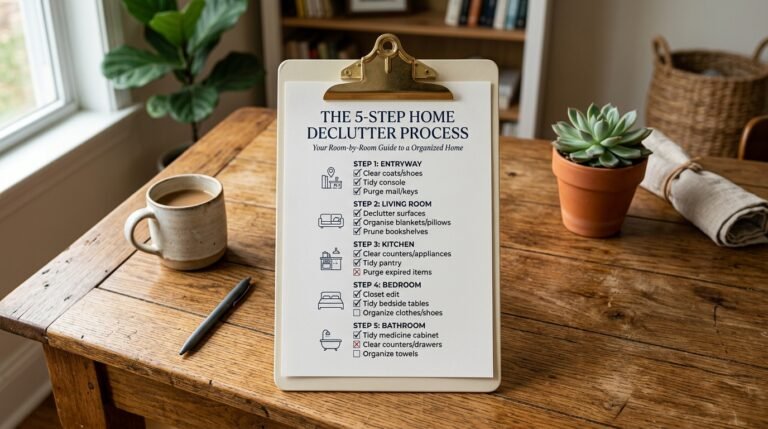
For the rest of the garage, use our 5-Step Home Declutter Process. If you are helping family, read How to Help a Parent Declutter Without Taking Over. Working toward a move? Add this errand to your moving plan.
The goal is a confirmed exit for each product. Once you know what goes where, the shelf stops being a mystery and becomes a manageable errand.
U.S. guidance reviewed October 19, 2026. Disposal rules and service availability vary by location. Products, hours and collection limits can change; confirm with the receiving program before each trip. This guide covers household leftovers, not business waste or paint-removal debris.
Featured photo: Annie Spratt / Unsplash.