
Your First Home Organization System: What You Actually Need
At a glance: Give everyday belongings, incoming papers and important records a dependable home. Start with five simple zones, use containers you already have, and test the arrangement through an ordinary week before buying anything.
Setting up a first home brings a surprising number of small decisions. Where does the lease go? Which drawer holds the spare key? Why is the laundry basket always full while the chair beside it holds the clothes you wear again?
You can solve these problems one route at a time. A useful system connects where something arrives, where you use it and where it belongs afterward. These habits fit a first apartment, a shared rental or a fresh start at any age. Choose the parts that match your household.
Start with the three searches you repeat
For the next few days, notice what makes you stop and look. Keys, a work badge, a charger and a particular shirt may cause more daily friction than a disorganized storage cupboard. Write down your three most frequent searches and begin there.
Choose locations close to the action. If your keys land on the kitchen counter because that is where you enter, a tray there may work better than a beautiful organizer beside another door. Tell anyone sharing the space which locations are personal and which are shared.
Build five small zones
Treat each zone as a job that needs a place. A shelf, an envelope and a reused basket can do useful work while you learn what fits.
- Everyday essentials: one landing place for keys, wallet, bag and items that must leave with you tomorrow.
- Incoming papers: one temporary inbox for mail, forms and notices that need attention.
- Laundry: a clear route from worn clothes to washing, drying, folding and putting away.
- Cleaning supplies: a manageable set kept in suitable locations and stored according to the product labels.
- Important records: a protected folder or file for identification, housing records, insurance information and essential contacts.
Keep these zones small enough to reset easily. Shared homes may need a separate essentials spot for each person. Avoid placing baskets or bags where they narrow an entrance or walking route.
Give paperwork a next action
During a short weekly review, move each paper toward an outcome: act on it, retain it securely or dispose of it appropriately. Write the action on a separate task list if a form needs a call, signature or payment. A growing stack rarely explains what needs doing.
For retained records, start with broad labels such as Housing, Work, Health and Vehicle. The FTC’s document guidance distinguishes records to retain from papers to shred. Check requirements for your circumstances before discarding originals, tax records or legal documents.
Protect the digital side of the system
A phone full of document photographs can become another place to search. Give useful scans clear names, keep them in a protected location and know how you would retrieve them if the phone were lost. A scan may help you find information, but some organizations still require original records.
The FTC recommends strong passwords and two-factor authentication for online accounts. Use your existing password manager or supported device tools. Keep login credentials out of a general household checklist, and review account-recovery information through the provider’s official settings.
Make the routine fit the week you actually have
Trace the laundry route once. If clean clothing never reaches a drawer, check whether the drawer is overfull or the folding location is inconvenient. If mail builds up, choose a review time linked to something you already do, such as checking the coming week’s calendar.
Buying storage is a later decision. Empty and measure the problem area first. Try an available container for a week, then decide whether a purchase would solve a specific problem. Keep cleaning products in their original containers, follow their labels and never combine products.
Use a seven-day trial
Spread the setup across a week: notice recurring searches, choose an essentials spot, establish the paper inbox, improve the laundry route, arrange cleaning supplies, gather essential records and review the results. You can combine days or take longer when your schedule requires it.
At the end, ask three questions: Did I find things faster? Could I put them away without a complicated sequence? Did everyone using the space understand the arrangement? Change one awkward detail and try again. A system earns its place by being usable.
Example: a setup that fits a shared rental
Imagine an apartment with one narrow entrance and very little spare storage. Each resident chooses a hook for the bag used most often, with a small shared tray for outgoing post. An envelope in a protected drawer holds housing records. A separate inbox receives forms that still need action. Nothing requires a new cabinet.
After a week, the residents notice that a large laundry basket blocks the route to a door. They move it to a better location and keep the useful habits. The point of the trial is to discover what works in that space. Someone moving in later can learn the arrangement through a short explanation rather than a complicated set of rules.
Keep the habit as life changes
The physical setup will evolve. A single key tray may become several household hooks. A housing folder may grow when you move, buy property or help a relative. Keep the useful habit of giving important things a clear location, then adjust the container when circumstances change.
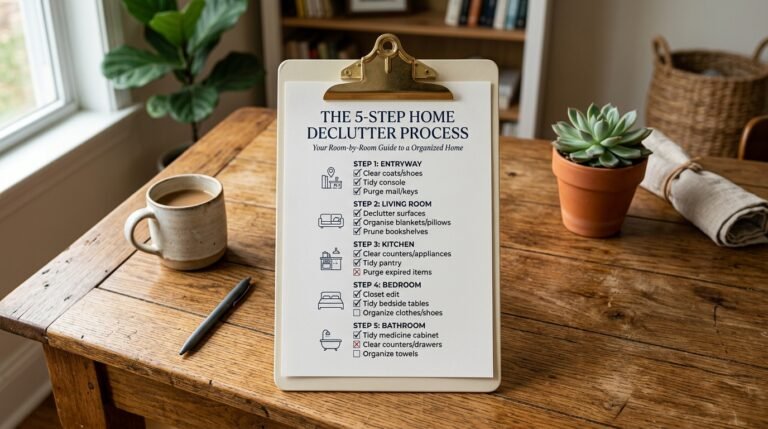
Your first step can be modest: choose one recurring search, establish its home and use that location today. For a larger clear-out, follow our 5-Step Home Declutter Process before reorganizing the rest.
Your first 15 minutes
- Choose one landing spot.
- Put today’s keys, wallet or bag there.
- Schedule a short paper review and test both habits for a week.
Related Organize-Declutter guides
Featured photo: Clay Banks / Unsplash.